Neuroscience of Lived Experience

Also listen on
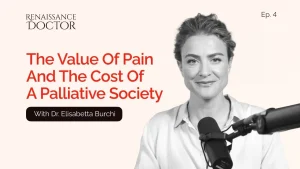
We live in the most comfortable civilization in history — so why are anxiety, depression and loneliness defining our age? What if some forms of pain aren’t obstacles to wellbeing, but conditions for it? In this episode of The Renaissance Doctor, clinical psychiatrist Elisabetta Burchi explores the value of pain — arguing that a life organized around the elimination of all friction quietly weakens the very systems that let us experience pleasure, meaning and love.
⚠️ This episode discusses pain, loss and suffering. If you’re struggling, please reach out to a qualified professional or a local support service.
▶ THIS EPISODE IS FOR YOU IF
▶ WHAT YOU’LL LEARN
Your Host

MD · MBA · Clinical Psychiatrist · Neuromodulation Researcher · Science Communicator
The Enlightenment introduced one of the most influential ideas in modern history – the idea of progress. The idea that history followed a linear, inevitable, upward trajectory towards human emancipation and freedom.
In many respects, this vision has captured something real about the history of civilization and has also generated remarkable achievements. Think of the recognition of human rights. Think of the technological advances that have dramatically increased life expectancy or the unprecedented access to knowledge.
We could say that ours is probably the most comfortable civilization history has ever seen, meaning with “comfort” a condition in which certain needs can be satisfied with less friction and less delay.
And yet, despite unprecedented levels of material comfort, anxiety, depression and loneliness have become defining public health challenges of our time. Many explanations have been proposed for this apparent contradiction.
One might argue that there is no contradiction because there is no actual increase in mental health burden and that the increasing prevalence of these diseases is apparent, reflecting just greater awareness, better diagnosis, or a greater willingness to speak openly about psychological suffering.
One might argue that material comfort and human fulfillment are totally unrelated. Or that material comfort is necessary, but not sufficient for human flourishing. Or instead, that it can even be detrimental to it.
We might also argue that the issue lies in the definition of comfort. That the shortcomings of our society come from having become extraordinarily effective at satisfying certain human needs, while totally neglecting others.
Aware of the complexity of the topic, I would like to explore only one possible hypothesis underpinning this paradox. What if some forms of discomfort, or to use a stronger term, pain, are not obstacles to wellbeing, but necessary conditions for it?
Ciao. I’m Elisabetta Burchi, physician, clinical psychiatrist and host of the Renaissance doctor. I’ve always been drawn to paradoxes. Perhaps because they signal that our understanding of reality is incomplete and yet that God does not play dice with the universe.
Because paradoxes are a privileged way towards a more complete understanding of reality. The moment when two apparently contradictory truths both turn out to be real.
And understanding why leads to a broader understanding of reality. Today’s episode revolves around one such paradox. What if the systematic elimination of friction comes at a cost? In the previous episode, we explored how addiction can be understood as a disorder of learning, as a condition in which the brain becomes progressively oriented towards immediate rewards, and progressively less capable of pursuing more meaningful but effortful goals.
Today I would like to push that idea one step further. What happens when the environment itself systematically removes friction? What happens when comfort becomes an end in itself, detached from growth?
Today we will explore the value of pain. And we will ask whether some of the very experiences modern society encourages us to avoid – to avoid pain – may be precisely those that allow us to become more fully human.
I’ve always believed that our experience of life is shaped less by the objective events that happen to us, than by the meaning we assign to them. Of course, certain experiences are objectively more difficult to become generative than others for everyone.
I am reminded here of one of the most extraordinary passages in literature, the Grand Inquisitor in the Dostoevsky’s The Brothers Karamazov, The Grand Inquisitor accuses Christ of having asked too much of humanity: freedom.
According to him, most people do not truly want freedom. They want certainty, security, comfort. And they are willing to surrender freedom, in exchange for them. Because freedom entails uncertainty, responsibility, anxiety, suffering.
But how much freedom are we willing to sacrifice in exchange for comfort or lack of suffering?
We are all challenged by pain, by giving meaning to suffering. I’ve always been naturally and culturally inclined to look for meaning in experience and trust that there might be some good,
even in those mysteriously painful experiences; at least, because they are generally a privileged way for genuine connections with others.
I’ve always seen suffering as emerging from vulnerability and vulnerability as a precondition for love between people. If I were perfect, I would be admired, not loved.
I need to be loved, exactly because I’m vulnerable. And that is the reason and the condition that makes me lovable. I do care a lot about these themes and often end up talking about them with my patients too.
Vulnerability is something people are generally ashamed of. And pain, it is something that even society as a whole, tends to hide and stigmatiseas something to eliminate. I think that the lapidary definition that Byung Chul has given of our contemporary society in “the palliative society” captures this problem strikingly well.
He talks about an universal algophobia, a culture that fights its obsession with pain, banning it from our lives. Not just physical pain, all forms of friction, difficulty, discomfort.
We live, he writes, in a palliative society, one that has elevated the elimination of pain to the supreme value. The consequence, he argues, is a culture of anaesthesia. Our societies today are characterised by universal algophobia, a generalised fear of pain.
We strive to avoid all painful conditions. Even the pain of love is treated as suspect. The paradox is that, banning pain, we are banning the condition of life itself. The other face of the coin is that we are prepared to sacrifice everything that makes life worth living for the sake of survival.
I find this trenchant analysis very relevant for all of us. We can all see around us this reflexive reach for the painkiller, either physical, digital, pharmaceutical, emotional. The cultural message that discomfort is a problem to be solved, rather than an experience to be understood.
The optimization of everything towards frictionlessness impulses rather than desires which cannot even emerge because impulses can immediately be gratified with no effort. Efficiency that replaces meaningfulness.
Because if we skip effort, we have not even the mental space for becoming aware of why we are pursuing something. Now, I want to be careful here. I don’t want to romanticise pain, promote masochism, nor fetishize difficulty.
There is a suffering which we should not accept as a society. The suffering that stems from injustice, non-recognition of dignity, lack of opportunities, or that biological pain that doesn’t leave any room for authentic expression of the self.
But what happens when we extend the palliative logic to all discomfort:
Will we be able to grow as citizens, as professionals, as friends, as lovers without any acceptance of pain? Let me invite you into a thought experiment with me. Let’s think about experiences in our life that most shaped who we are.
In my case, most of them involved uncertainty, loss or challenge. If you have listened to my previous episodes, you might have noticed I like to resort to definitions. So what do we mean by pain?
From a biological standpoint pain is an adaptive, multidimensional biological process in which the nervous system detects actual or potential threats to bodily integrity, integrates sensory, cognitive, emotional and contextual information and generates protective responses that may include the conscious experience of pain.
This process is a vital process. We can see this from the tragically rare cases of children born with congenital insensitivity to pain, individuals who suffer severe repeated damage to their bodies precisely because they cannot learn from injury.
Now bring this back to the dopamine system I described in our previous episode. You might recall that phasic dopamine release encodes the difference between expected and actual outcomes. Well – events that are either automatically perceived as painful or interpreted as painful can generate negative prediction errors if they represent outcomes that are worse than anticipated.
A negative prediction error, when things are worse than expected, diminishes dopamine firing. And this is how the brain learns from pain and updates our own model of the world. Another interesting facet that corroborates the relevance of pain biologically and its intertwined nature with pleasure is described by the so called opponent-process, hypothesised in the field of psychology, but then confirmed by neuroscientific findings too.
It describes the tendency of the nervous system to generate an opposing emotional or motivational state after any strong affective experience, thereby pulling the organism back towards equilibrium. Studies have shown that repeated intense rewards, tend to provoke compensatory adaptations that can lower subjective well being while tolerating manageable discomfort can sometimes enhance later wellbeing and reward sensitivity.
Basically when we experience pain and work through it, a restored capacity for pleasure follows. What the palliative society disrupts is exactly this balance.
When we systematically suppress the pain side of the scale through anaesthesia, digital escape, constant stimulation, and avoidance of all difficulty, we don’t eliminate pain. We accumulate an internal deficit that will eventually assert itself.
But the story doesn’t stop at physical pain. If we get to emotional pain, the definition raises up a level of complexity. We can define emotional pain as an aversive conscious state that signals the actual or anticipated loss of something the mind represents as important.
It has been shown that emotional pain – the pain of rejection, exclusion, loss – activates many of the same neural circuits as physical pain. The anterior cingulate cortex which processes the emotional distress component of physical pain is the same region that responds to feelings of being excluded from a social game, to losing a relationship or to grief.
From an evolutionary perspective, social connection is survival-critical. But what is important to highlight here is that pain might not just be informative about “avoiding certain stimuli”, but also about what matters.
Emotional pain is not merely a feeling, but a signal of significance. The emotional pains of human life – frustration, failure, loneliness, grief, the discomfort of not-yet-knowing – are the brain signalling that there is something that matters.
Again – emotional pain is subjective with a felt negative quality experience through which the brain registers and communicates the importance of loss, unmet needs, thwarted goals and violated expectations to valued relationships and self concepts. And its function is to direct attention, learning and behavioural adaptation towards matters of high personal significance.
Even the perception of physical pain can be different between different people. But the variation in the perception of emotional pain is highly more variable because emotional pain tracks appraised loss nor objective loss. This appraisal based nature is why emotional pain is deeply connected to meaning and identity rather than merely to external events themselves.
Before moving further, I want to introduce one more concept. Between pain and suffering lies a more ordinary everyday: frustration. Frustration is what happens when reality doesn’t immediately comply with our desires, when a goal is delayed, when an effort doesn’t yet produce results, when a need remains temporarily unmet and if pain teaches us what matters, frustration teaches us how to persist.
This is important because, while pain is unavoidable, frustration is increasingly optional. Modern environments are extraordinarily effective at reducing it.
Immediate on demand delivery. Many of the technologies we celebrate are, in part, technologies of frustration reduction. Yet frustration may be one of the most important psychological conditions for learning, development and ultimately freedom.
Which brings us to a question: What happens when we lose the capacity to tolerate frustration?
Frustration tolerance is the ability to remain goal-oriented in the presence of unmet needs, delays, obstacles and uncertainty without collapsing into avoidance and aggression or compulsive self-soothing.
The newborn has essentially zero frustration tolerance. Any discomfort is met with immediate undifferentiated distress. The developmental journey of childhood is, in a way, the gradual expansion of this window.
The capacity to wait a little longer, to tolerate a little more uncertainty, to sustain effort in the face of difficulty without fleeing. And the crucial insight here is this: frustration tolerance is not built by the absence of frustration.
It is built by the experience of frustration that is manageable; frustration that is met with appropriate support and that is worked through, integrated. A child who is never allowed to experience frustration, whose every discomfort is immediately resolved, does not develop the capacity to tolerate it.
Let’s now connect this to what we discussed in episode 3.
Recall one of the hallmarks of addiction stages is the profound loss of the capacity for natural rewards.
A system trained on amplified effortless stimulation loses its responsiveness to ordinary life. There is something close to this, something we can see, unfortunately, in many people who have not yet developed any diagnosable addiction, but who are already showing the signature of an undertrained frustration-tolerance system: a pervasive sense that anything requiring sustained effort is simply not worth it.
And we should think about that because the consequences extend far beyond any symptom. Because the things that matter most in life – deep relationships, meaningful work – all of them require the sustained tolerance of frustration.
They require the capacity to remain in the discomfort of not-yet.
Now let me go even further – to a higher layer and define “suffering”. In philosophy, pain and suffering are not interchangeable. If emotional pain is the felt signal of cognitive importance under conditions of loss, then suffering could be defined as the sustained distress that arises when a significant loss, threat or frustration, is integrated into one’s understanding of oneself.
Pain is something we experience. Suffering is what happens when pain becomes part of our story. Two people may endure similar losses and yet suffer in profoundly different ways. Because suffering depends not only on what happens to us, but also on how we interpret what happens.
Meaning does not eliminate pain, but it can transform suffering. Viktor Frankl understood this very well. As a psychiatrist who survived Auschwitz, Frankl spent his post-war career elaborating what he called logotherapy, the recognition that the primary human drive is not pleasure or power, but meaning.
And what he observed in the camps, in conditions of extremity, was this: that people who survived psychologically and physically were those who found a way to attach meaning to their suffering. According to Frankl’s formulation: he who has a why to live, can bear almost any how. The clinical implications I think are profound. When I work with patients, one of the central questions is not simply how do we reduce the pain, but how can we find together meaning in this pain?
And the cultural implication is equally important because a society that treats all pain as pathology, that regards all difficulty as something to be medicated, distracted from or optimised away, has lost the capacity to find pain to be also generative.
In collapsing the distinction between meaningful and meaningless pain, the palliative society has lost the capacity to grow through difficulty. I would like to share one memory. When I was doing my MBA at insead, immersed in the world of business, finance and strategy, I was asked to do an interesting exercise.
They called it the “10 images exercise”. 10 images to represent who we are, our values, our way of seeing the world. Among these images, I chose an image of the Sermon on the Mount from the Bible.
I wanted to represent what I think is the most radical disruptive paradox at the heart of the Christian worldview. The revolutionary paradox of love.
In the sermon, the qualities normally associated with weakness, are presented as the conditions for the highest form of human flourishing. From the perspective of evolutionary competition, political power, social dominance or economic success, none of those characteristics would ever appear advantageous.
And yet, the sermon proposes a radical inversion of values. The very vulnerability that makes us capable of suffering is also what makes us capable of loving and therefore capable of living a meaningful life.
It is in giving fully yourself to others without any reservation, that you find the fullness of life. That, I think, is the most paradoxical of all paradoxes. The paradox of unconditional love.
And yet, I believe, it captures probably the most profound truth about the human condition.
The paradox of this episode is more humble. But along these lines, a civilization that eliminates all difficulty doesn’t produce flourishing. A person who cannot tolerate frustration cannot access the best parts of themselves.
Pain held with meaning does not diminish life – it deepens it.
Let me wrap up. What I find remarkable is that very different traditions of thought seem to have arrived, at a surprisingly similar conclusion.
Neuroscience approaches the topic of pain through the language of circuits, dopamine, learning and adaptation, and highlights that a life organised around the avoidance of all discomfort ultimately weakens the very systems that allow us to experience pleasure, motivation, and agency.
Logotherapy approaches this through the language of meaning, and suggests that meaning does not remove pain, but can totally transform our experience of it. Religious traditions have long approached the same question through the language of transcendence and witness, and have long suggested that the core of being human lies in a form of love which cannot exist without vulnerability and sacrifice.
Everything seems to point to the same reality. Perhaps the goal is to stop treating every form of discomfort as an enemy. Human beings do not flourish through the elimination of all discomfort. They flourish through the capacity to engage with difficulty in the service of something that matters.
Some forms of pain diminish us and should be alleviated whenever possible. But others accompany the very experiences that make life meaningful.
The problem, I think, is not pain itself. The problem is pain detached from meaning, because comfort can make life easier. But meaning is what makes life worth living. And meaning rarely emerges in the absence of friction. It emerges through engagement, through vulnerability.
Perhaps progress should not be measured only by the level of comfort we create.
Perhaps it should also be measured by how much meaning we are capable to create.
In the next episode, we will follow these threads even further.
If reward, detached from effort, can distort learning, and if comfort, detached from growth, weakens our capacity to tolerate frustration, then a deeper question. What is it human beings are ultimately seeking?
How do we experience desire in our contemporary society? I will see you.
Share This Podcast
Enjoy New Podcasts